


Intel is reportedly preparing for the launch of its Core Ultra Series “Nova Lake-S” processors in late 2026. Leaked information now details the associated 900-series “Nova Point” chipset family. This new generation is expected to bring significant changes to platform architecture, including the introduction of the LGA 1954 socket and a more segmented approach to chipsets.
Leaks from Jaykihn, reported by VideoCardz, indicate that the “Nova Point” chipset lineup will feature five different PCH variants: Z990, Z970, W980, Q970, and B960. The “H970” tier is reportedly being omitted due to low demand, with Intel instead focusing on two enthusiast-level chipsets. The top-tier Z990 is expected to be the sole consumer chipset supporting both multiplier and base clock (BCLK) overclocking, along with substantial I/O enhancements. It is rumored to provide a total of 48 PCIe lanes, with 12 of these being PCIe 5.0 lanes directly from the chipset.
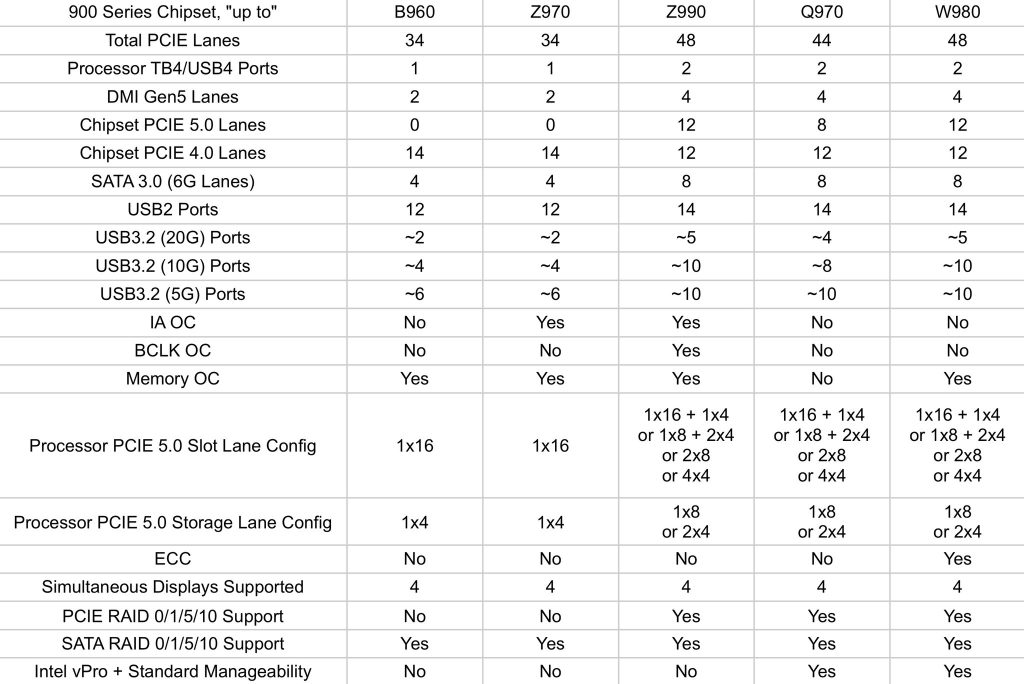
Image credit: Jaykhin
The Z970 is a new addition, positioned below the flagship and aimed at mainstream enthusiasts. This chipset is expected to support multiplier-unlocked “K” series processors and memory overclocking, but reportedly will not offer BCLK tuning. It is also said to lack PCIe 5.0 lanes from the chipset, instead providing a 14-lane PCIe 4.0 configuration. The Z970 reportedly shares a smaller physical PCH die with the B960, which is positioned as the mainstream option. The B960 will support memory overclocking but will not allow CPU frequency adjustments.
The “Nova Point” platform is rumored to significantly enhance the communication bandwidth between the CPU and the motherboard. The Z990, W980, and Q970 chipsets are expected to utilize a DMI Gen 5 x4 link, offering approximately 128 Gbps of bandwidth. In contrast, the Z970 and B960 will reportedly use a DMI Gen 5 x2 link. This differentiation implies that Z990 motherboards will be better suited for configurations involving multiple Gen 5 NVMe drives and high-bandwidth USB4 devices, avoiding potential data bottlenecks.
Regarding the processor, Nova Lake-S is rumored to offer up to 32 PCIe Gen 5 lanes, a substantial increase from the 20 lanes available on Arrow Lake. This could enable a full x16 Gen 5 graphics card to operate concurrently with two or three Gen 5 x4 SSDs directly connected to the CPU. The processor’s direct connectivity is also expected to improve, with high-end chipsets supporting two 40 Gbps USB4/Thunderbolt 4 ports routed via the processor.
